
 Strategic Plan 2025-2030
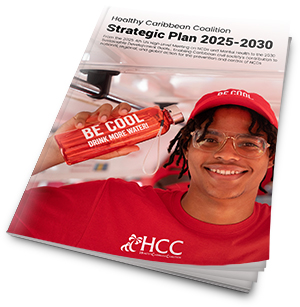
From the 2025 4th UN High Level Meeting on NCDs and Mental Health to the 2030 Sustainable Development Goals… Enabling Caribbean civil society’s contribution to national, regional, and global action for the prevention and control of NCDs.
Focus
The HCC’s Strategic Plan 2025-2030 underpins the work of the Coalition and shapes the continued contribution of civil society to NCD prevention and control in the Caribbean over the next five years.
This roadmap for action informs the direction of the HCC at a pivotal time, as the global community takes stock of NCD progress at the 4th United Nations (UN) High Level Meeting on NCDs (HLM4) in September 2025 where Heads of Government and State will be expected to agree on ambitious, timebound political commitments to guide national, regional, and global action over the next five years in support of achieving Sustainable Development Goal (SDG) SDG 3.4 and the other interlinked 16 goals in the broader SDG agenda.
Inspiration
The 2025-2030 Strategic Plan builds on previous HCC strategic plans, including the HCC Strategic Plan 2012-2016, Civil Society Action Plan (CSAP) for Preventing Childhood Obesity in the Caribbean 2017-2021, HCC Strategic Plan 2017-20216 and the 2021-2022 Transformative New Agenda and Action Plan.7 Lessons learned from the implementation of these plans, as well as a number of external evaluations of the previous Strategic Plans and the CSAP, informed the content of the Plan.
Development
The Strategic Plan was co-developed by an external firm, HCC’s core team, and the Board of Directors in consultation with HCC’s civil society membership and HCC’s key stakeholders, including funders and implementing partners. To ensure that the Plan reflected the strategic direction of the Coalition within an evolving regional and global NCD context, the priority needs of HCC’s membership and key regional stakeholders, and the organisational capacity of the HCC, wide stakeholder inputs were sought. Comments were received through a series of consultations held at various stages of the development of the Plan, including conceptualisation, development of the first draft, and finalisation.
View/Download the HCC Strategic Plan 2025 – 2030 here.
Transformative New NCD Agenda HCC Action Plan 2021-2022
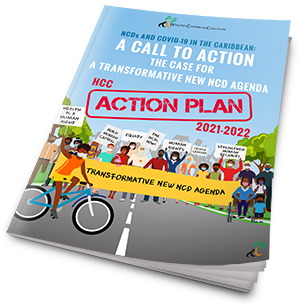 The Healthy Caribbean Coalition (HCC) Action Plan 2021-2022 represents the HCC’s contribution to implementation of the Transformative New Agenda for the Prevention and Control of Non-communicable Diseases (TNA-NCDs) in the Caribbean during, and in the aftermath of, the coronavirus disease 2019 (COVID-19) pandemic.
The HCC developed the TNA-NCDs as a call to action for innovative, bold approaches to NCD reduction in the Caribbean region to address the inequities, health system gaps, and implementation deficits laid bare by COVID-19. The TNANCDs embraces new approaches to accelerate NCD reduction in the Caribbean, based on principles of equity and human rights, and enhancement of the region’s human security and human capital. It provides impetus for social activism that puts persons living with NCDs (PLWNCDs) at the heart of a new framework to which governments, civil society, the health-supporting private sector, and development agencies can contribute, collaborating to step up reduction of the region’s crushing burden of NCDs.
Strategic Plan 2017-2021
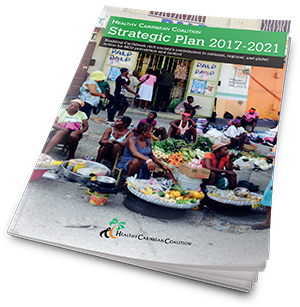
The HCC Strategic Plan 2017-2021 : Enabling Caribbean civil society’s contribution to national, regional, and global action for NCD prevention and control, was published in February 2017. View/Download the HCC Strategic Plan 2017 – 2021 here.
The Plan has five strategic pillars: accountability, advocacy, capacity development, communication, and sustainability. These five strategic pillars and their associated high level objectives which provide the basis for the development of annual operational plans with specific outputs, deliverables (products and services), activities, inputs, and resource.
These strategic pillars and their associated high-level objectives provide the basis for the development of annual operational plans with specific outputs, deliverables (products and services), activities, inputs, and resource needs, as well as a monitoring and evaluation (M&E) framework.
The HCC 2017-2021 Strategic Plan charts a course for the work of the Coalition in the coming five years. The streamlining and prioritising of key actions will lay the foundation for HCC’s contribution to the region’s achievement of national, regional, and international NCD targets, reduction of inequities, and, ultimately, reduction in NCD-related premature mortality, as we navigate through the post-2015 development era.
In the Caribbean, the five major NCDs – cardiovascular diseases, diabetes, cancer, chronic respiratory diseases and mental health diseases – and the five common risk factors – tobacco use, harmful use of alcohol, physical inactivity, unhealthy diet, and air pollution – are the leading causes of death and illness. The region has the highest mortality from NCDs in the Region of the Americas(1); they cause 3 of every 4 deaths. Forty percent of deaths due to NCDs occur prematurely, in persons under 70 years of age, and most premature deaths are caused by heart attack, stroke, and diabetes, followed by cancer. Hypertension is the leading contributor to heart attack and stroke, and diabetes prevalence in the region is twice the global average(2). Mental health disorders contribute to significant morbidity in the Caribbean; a review of mental health in disaster situations in the region presented data – albeit limited – on psychotic, mood, and anxiety disorders; suicide; and dementia (3)
Strategic Plan 2012-2016
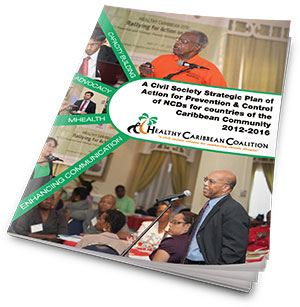
The predecessor to the 2017-2021 Strategic Plan was published in December 2012, following the successful Rallying for Action on NCDs conference which took place in Jamaica, May 27-29, 2012.
A Civil Society Strategic Plan of Action for Prevention & Control of NCDs for countries of the Caribbean Community 2012-2016.
View/Download the HCC Strategic Plan 2012-2016 here.
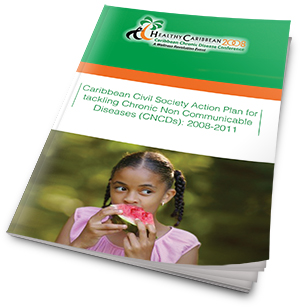
Strategic Plan 2008-2011
This plan was published following the Healthy Caribbean 2008 – A Wellness Revolution Conference.
Caribbean Civil Society Action Plan for tackling Chronic Non Communicable Diseases (CNCDs): 2008-2011.
View/Download the HCC Strategic Plan 2008-2011 here.
1. PAHO. Health Situation in the Americas: Core Indicators 2016. Washington DC: PAHO/WHO, 2016. http://iris.paho.org/xmlui/bitstream/handle/123456789/31289/CoreIndicators2016-eng.pdf?sequence=1&isAllowed=y.
2. Port of Spain Declaration Evaluation Research Group on behalf of PAHO/WHO and CARICOM. Evaluation of the 2007 CARICOM Heads of Government Port of Spain Declaration. September 2016. http://www.onecaribbeanhealth.org/wp-content/uploads/2016/10/ACCELERATING-ACTION-ON-NCDS-POSDEVAL-Report.pdf.
3. Abel W, Baboolal N, and Gibson R. The epidemiology of mental health issues in the Caribbean. Chapter 5 in PAHO. Mental health and psychological support in
disaster situations in the Caribbean: Core knowledge for emergency preparedness and response. Washington, D.C.: PAHO, 2012. http://www.paho.org/hq/index.php?option=com_topics&view=readall&cid=7295&Itemid=40870&lang=en.