
Public health is built not on good intentions alone, but on strong, enforced legislation. Barbados has already demonstrated this truth across multiple areas of national life. We accept and comply with seatbelt laws because they save lives. We respect smoke-free public spaces because they protect citizens from harm. More recently, we have supported anti-gang legislation as a necessary intervention in addressing crime—not only as a security issue, but as a public health concern.
These policies do more than regulate behaviour; they reshape environments in ways that make safer, healthier choices the default. They reduce risk, protect the vulnerable, and ultimately save lives. Importantly, they remind us that when a threat to national well-being is clear, decisive action is not optional—it is essential.
Today, Barbados faces another urgent and escalating public health threat: childhood obesity. The data tells a stark and troubling story. Over the past four decades, childhood overweight and obesity in Barbados has surged from less than 5% in 1981 to over 30% by the early 2000s, and now to approximately 42% among children aged 5–19. Even within the last decade, rates have climbed significantly from 33% in 2012 to 42% in 2022, confirming that the trajectory is still rising.
To put this into perspective, Barbados’ childhood obesity rate is now more than double the global average of approximately 20%. Across the Caribbean, the problem has reached crisis proportions, with millions of children affected and rates more than doubling over the past 30 years.
This is not simply about weight. It is about health outcomes and national development. Children are now developing conditions once seen only in adults—hypertension, type 2 diabetes, and cardiovascular risk factors—at increasingly younger ages. Left unchecked, this trend will translate into a heavier national burden of non-communicable diseases.
And nowhere is this issue more immediate—or more preventable—than in our schools.
Barbados already has a school nutrition policy in place. However, as our experience with other public health interventions shows, policy without enforcement is ineffective. Smoke-free legislation only worked because it was actively implemented and monitored. Seatbelt laws became normalized because compliance was expected and enforced. Similarly, anti-gang legislation will only succeed if it is consistently applied, addressing the root environmental drivers of violence and risk.
There is often debate about where responsibility lies—whether with parents, children, or the state. The reality is that effective public health policy recognizes shared responsibility, while acknowledging a fundamental truth: environment shapes behaviour.
This is why strengthening and enforcing school nutrition standards is not an overreach—it is a necessary evolution in public health policy. Schools must become environments where healthy choices are not just encouraged, but normal, accessible, and expected.
The success of our past legislative efforts provides a clear blueprint. We did not hesitate to act when road safety was at stake. We did not delay when evidence confirmed the dangers of public smoking. We are now confronting crime through a public health lens.
Childhood obesity deserves the same urgency and seriousness.
By strengthening and enforcing school nutrition policy, Barbados has an opportunity to decisively interrupt a decades-long upward trend—one that has moved from rare in the 1980s to affecting nearly half of our children today.
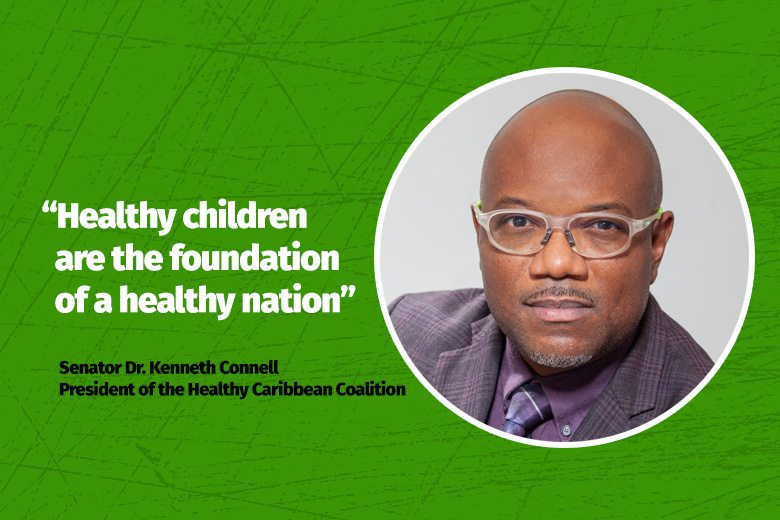
Healthy children are the foundation of a healthy nation. The evidence is clear, the precedent is established, and the time to act is now.
Sincerely,
Senator Dr. Kenneth Connell
President of the Healthy Caribbean Coalition
Media coverage: