
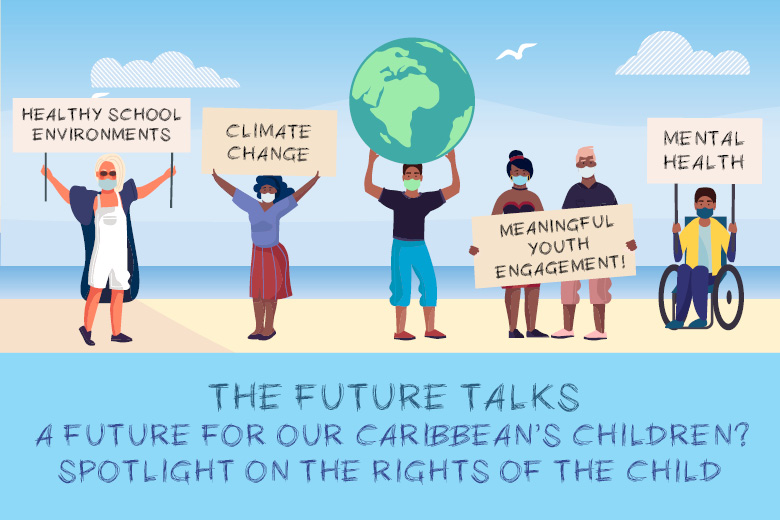
 The Future Talks: A Future for Our Caribbean’s Children? – Spotlight on the Rights of the Child. Children are repeatedly described as “the future” whether in political discourse[1], popular songs[2] or just among the general population. Yet, children’s rights are not often prioritised in decision making, even when children’s health and wellbeing and by extension, the future, depends on such. In fact, this particular tranche of the population, including those up to 18-years-old,[3] are often excluded from participating in decision-making processes, even when an appropriate age and maturity level has been reached. Children, though dependent on parents or guardians especially in their initial years – albeit small in stature – are fully entitled to the panoply of inalienable rights. This preliminary article in the Healthy Caribbean Youth’s (HCY) “The Future Talks: A future for our Caribbean’s Children?” series, inspired by the 2020 “A Future for the World’s Children?’ Commission[4] convened by the World Health Organization, United Nations Children’s Fund and the Lancet, acknowledges that it is impossible to accurately represent each child’s unique voice. However, it aims to amplify children’s collective voices by emphatically making their rights more widely known, especially their right to health.
The United Nations Convention on the Rights of the Child (CRC)
Children’s rights are vividly affirmed in the CRC, an international treaty or binding agreement among States. This treaty covers an array of civil and political rights, such as the child’s right to life (Article 6) and freedom of expression (Article 13) as well as economic, social and cultural rights, such as the right to health (Article 24) and the right to education (Article 28), among several other rights.[5] Various other international instruments, such as the International Covenant on Economic, Social and Cultural Rights,[6] also establish children’s rights, including the right to health (Article 12).
The clear articulation of children’s rights in not one, but several international instruments, has a legitimizing and amplifying effect on the clarion calls of children, youth and their supporters for the realisation of rights by States Parties. The CRC, for example, is “the most widely ratified human rights treaty”[7], including by ALL Member States of the Caribbean Community (CARICOM).[8] Consequently, ALL Caribbean children– from the north, in Nassau, Bahamas to Paramaribo, Suriname in the south– are today’s rights-holders and tomorrow’s beneficiaries of the legacy that duty bearers, namely States, will leave behind.
States’ obligations
Children, being dependent on and influenced by the State, civil society and the private sector, are vulnerable to having their rights disregarded, especially where profit-maximising interests supersede children’s best interests as a “primary consideration”.[9] Consequently, the existence of States’ obligations and due diligence responsibilities[10] of non-state entities is critical. In addition, the Commission’s call for an Optional Protocol to the CRC, that is, a further instrument, to treat fully with the “commercial marketing and targeting of children”[11] recognises the unique vulnerabilities of the world’s children especially in the face of industry players and ought to receive strong support from States and child allies everywhere.
States are legally obligated to respect, protect and fulfil children’s rights under the CRC.[12] They must refrain from infringing children’s rights under the obligation to respect whilst also taking positive action to facilitate and promote children’s rights under the obligation to fulfil. States’ protection obligation requires action to prevent third parties’ interference with children’s rights. The obligation “to protect both freedoms and entitlements from third parties or from social or environmental threats”[13] is increasingly critical to realizing the child’s right to health,[14] since “a wide range of duty bearers need to be involved”.[15] This protection obligation is relevant to tackling noncommunicable diseases (NCDs) and their risk factors such as tobacco use, alcohol consumption and unhealthy diets seemingly being ‘force-fed’ to Caribbean children largely in the form of unrestricted access to and the marketing of those unhealthy products.
Industry’s driving force behind the childhood NCD crisis[16] must be immediately curtailed by States. States must take the wheel again and with the support of legitimate health-promoting partners riding shotgun, steer ALL towards a brighter future. The ‘backseat’ driving tactics of industry players to infringe children’s rights must be called out and controlled. As emphasised in the 2020 Statement of the UN Special Rapporteur on the Right to Health,[17] the obligation to protect against third parties can be violated by a State’s “failure to regulate the activities of corporations to prevent them from violating the right to health of others [including children], and the failure to protect consumers [including parents and children]” (emphasis added).
Legislative and regulatory measures, such as marketing restrictions, front-of-package nutrition warning labels and unhealthy product taxes are within States’ reach, yet Caribbean children remain largely unprotected. Children, “the future” must continue to talk but duty bearers must listen and act.
The Way Forward
States should ensure that children, who are capable of forming their own views, have the right to express these views freely in all matters affecting them, regardless of the forum.[18] These opinions should be taken “in accordance with the age and the maturity of the child.”[19]
The region’s governments are essential in making sure that children’s voices are heard and their rights and entitlements are met, including their right to health[20]. Currently, it appears that children’s rights are rarely a unique concern for Heads of States and Prime Ministers. This area usually falls into the realm of smaller governmental departments.[21]
The private sector, once health-promoting, should be active participants in ongoing efforts to shape healthy environments for our children. This means that they should support bans or restrictions on the availability and marketing of unhealthy products in schools and other environments frequented by children. Digital environments have become key now that children are spending increasing amounts of time on screens and less time outside due to the ongoing COVID-19 pandemic.
The communities within CARICOM States all have a role to play in making sure that governments are upholding children’s rights. Pediatricians in the region stated[22] that “[s]ince the onset of the COVID-19 pandemic the lives of our children and young people have been turned upside down; the way that they learn, socialize, play, eat, move and sleep has changed, and these changes are having a substantial impact on their physical and mental health. We believe that we are on the cusp of a regional childhood obesity and mental health emergency.”
We, at Healthy Caribbean Youth, are determined to continue to advocate on behalf of children. As beautifully put by an ancient Chinese proverb, “[t]ell me and I forget, teach me and I may remember, involve me and I learn”. Children and youth advocates throughout the Caribbean must join together as the popular saying “nothing for us, without us” rings true.
———-
Anessa Anderson and Kimberley Benjamin are members of Healthy Caribbean Youth and attorneys-at-law called to the Bar in the Caribbean jurisdiction of Barbados.
This article is the first in the series The Future Talks: A future for our Caribbean’s children? which amplifies regional youth voices on concerns of the health and well-being of our region’s children and youth. For more information contact hcy@healthycaribbean.org.
References
[1] See e.g., “Children are the world’s most valuable resource and its best hope for the future.” – Re: United States Committee for UNICEF July 25, 1963. Papers of John F. Kennedy. Presidential Papers. White House Central Files. Chronological File. Series 1. President’s Outgoing Executive Correspondence, Box 11, Folder: July 1963: 16-31, JFKL. Available from: https://www.jfklibrary.org/learn/about-jfk/life-of-john-f-kennedy/john-f-kennedy-quotations.
[2] See e.g., “I believe the children are our future. Teach them well and let them lead the way. Show them all the beauty they possess inside.” – Whitney Houston. The Greatest Love of All. 1986.
[3] United Nations Convention on the Rights of the Child. Treaty No. 27531. United Nations Treaty Series 1577. Available from: https://treaties.un.org/doc/Treaties/1990/09/19900902%2003-14%20AM/Ch_IV_11p.pdf. Article 1: “For the purposes of the present Convention, a child means every human being below the age of eighteen years unless under the law applicable to the child, majority is attained earlier.”
[4] A Future for the world’s children. A WHO-UNICEF-Lancet Commission https://www.thelancet.com/commissions/future-child
[5] Civil and political rights are explicitly recognized in several Caribbean Constitutions. However, economic, social and cultural rights are only explicitly mentioned in a few Constitutions of the Caribbean.
[6] United Nations International Covenant on Economic, Social and Cultural Rights. United Nations Treaty Series, vol 993. Available from: https://treaties.un.org/doc/Treaties/1976/01/19760103%2009-57%20PM/Ch_IV_03.pdf.
[7] United Nations Children Fund (UNICEF). The Convention on the Rights of the Child. Available from: https://www.unicef.org/child-rights-convention/what-is-the-convention.
[8] The CARICOM Member States are: Antigua and Barbuda, The Bahamas, Barbados, Belize, Dominica, Grenada, Guyana, Haiti, Jamaica, Montserrat, St. Kitts and Nevis, St. Lucia, St. Vincent and the Grenadines, Suriname and Trinidad and Tobago. The status of ratification of the CRC and other international treaties is available from: https://treaties.un.org.
[9] United Nations Convention on the Rights of the Child. Treaty No. 27531. United Nations Treaty Series 1577. Available from: https://treaties.un.org/doc/Treaties/1990/09/19900902%2003-14%20AM/Ch_IV_11p.pdf, Article 3.
[10] United Nations Convention on the Rights of the Child. Committee on the Rights of the Child. General Comment No. 15 (2013) on the right of the child to the enjoyment of the highest attainable standard of health (art. 24). CRC/G.GC/15, para 80 (Non-State service providers and other non-State actors – Private sector); Isabel Barbosa, Belén Ríos and Ariadna Tovar Ramírez. State Obligations in the Context of Unhealthy Diets: Paving the Way within the Inter-American Human Rights System. Revista Internacional de Derechos Humanos. E- ISSN 2422-7188 (2021) Vol. 11 No. 1 p. 43-72.
[11] Clark H, Coll-Seck AM et al. A future for the world’s children? A WHO–UNICEF–Lancet Commission. Lancet. 2020 Feb 22;395 (100224):605-658. doi: 10.1016/S0140-6736(19)32540-1. [p. 633].
[12] United Nations Convention on the Rights of the Child. Committee on the Rights of the Child. General Comment No. 15 (2013) on the right of the child to the enjoyment of the highest attainable standard of health (art. 24). CRC/G.GC/15, para 71 (State parties’ obligations to respect, protect and fulfil).
[13] United Nations Convention on the Rights of the Child. Committee on the Rights of the Child. General Comment No. 15 (2013) on the right of the child to the enjoyment of the highest attainable standard of health (art. 24). CRC/G.GC/15, para 71.
[14]United Nations Convention on the Rights of the Child. Treaty No. 27531. United Nations Treaty Series 1577. Available from: https://treaties.un.org/doc/Treaties/1990/09/19900902%2003-14%20AM/Ch_IV_11p.pdf, Article 24.
[15] United Nations Convention on the Rights of the Child. Committee on the Rights of the Child. General Comment No. 15 (2013) on the right of the child to the enjoyment of the highest attainable standard of health (art. 24). CRC/G.GC/15, para 6.
[16] United Nations. Report of the Special Rapporteur on the right of everyone to the highest attainable standard of physical and mental health, Anand Grover, to the Twenty-Sixth Session of the Human Rights Council. Unhealthy foods, noncommunicable diseases and the right to health. A/HRC/26/31. United Nations Human Rights Council: 2014.
[17] Dainius Pūras. Statement of the UN Special Rapporteur on the right to health on the adoption of front-of-package warning labelling to tackle NCDs (27 July 2020). (The Statement has been endorsed by: Michael Fakhri, Special Rapporteur on the right to food, and Surya Deva, Elżbieta Karska, Githu Muigai, Dante Pesce (Vice-Chair), Anita Ramasastry (Chair), Working Group on the issue of human rights and transnational corporations and other business enterprises. Available from: https://www.ohchr.org/EN/NewsEvents/Pages/DisplayNews.aspx?NewsID=26130&LangID=E.
[18] United Nations Convention on the Rights of the Child. Treaty No. 27531. United Nations Treaty Series 1577. Available from: https://treaties.un.org/doc/Treaties/1990/09/19900902%2003-14%20AM/Ch_IV_11p.pdf, Article 12.
[19] Ibid.
[20] United Nations Convention on the Rights of the Child (Adopted and opened for signature, ratification and accession by the General Assembly resolution 44/25 of 20 November 1989; entry into force 2 September 1990), Article 24.
[21] Clark H, Coll-Seck AM et al. A future for the world’s children? A WHO–UNICEF–Lancet Commission. Lancet. 2020 Feb 22;395 (100224):605-658. doi: 10.1016/S0140-6736(19)32540-1. [p. 624].
[22] Healthy Caribbean Coalition. Open Letter to the People of the Caribbean – Now More Than Ever, We Need To Act Now To Protect Children and Young People. 4 March 2021. Available from: https://www.healthycaribbean.org/we-need-to-act-now-to-protect-caribbean-children-and-young-people/.