
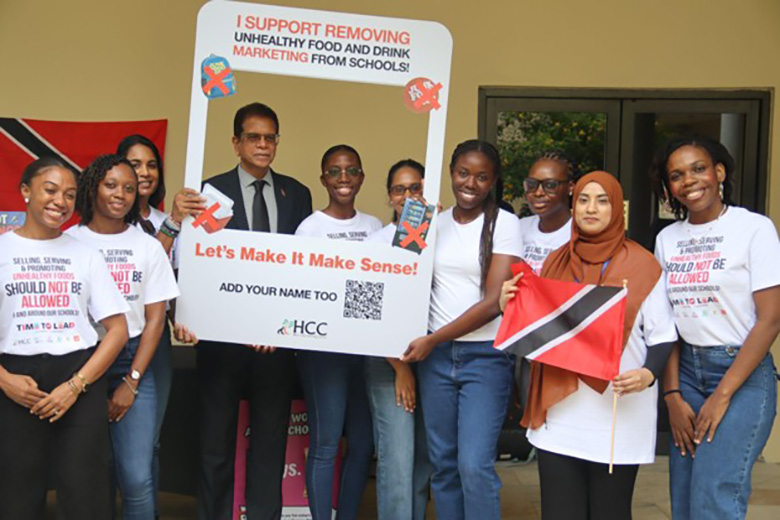
Minister of Education Honourable Dr. Michael Dowlath with Healthy Caribbean Youth Advocates Jenee Farrell, Chelsea Antoine, Rozette Scotland, Latifah Holder, TTANDi volunteers – Mizaaj Mohammed, Kyrie Aarti-Homer, Arianne Bernard, DATT Dietitian – Saffiyah Islam and TTNCDA Program Officer – Charissa David at the Hope for the Future 3.0 Event
How many fast food billboards and snack ads on bus stops do you typically pass on your way to work? Now imagine how many a typical child may pass on their way to school? Marketing of ultra-processed foods such as chips and soft drinks unfortunately does not stop at the schools’ doors, but has also infiltrated the school environment in the form of sports day sponsorships, and branding on school benches, cafeteria options, and even school supplies. With 1 in 4 school-aged children in Trinidad and Tobago being overweight or obese, greater scrutiny needs to be given to the immediate messages and environments around food inside schools. The policies being developed by our government to improve the nutrition of school meals are being drowned out by colorful, powerful marketing of less nutritious options.
Ultra-processed products (UPPs) that have been manipulated by machines and have many added chemicals and flavoring are often high in sugar, fat and salt but low in healthy nutrients such as fiber, protein and vitamins. These food products tend to displace nutrient-dense foods that are freshly prepared and minimally processed in children’s diets as they have more attractive advertisements, are more accessible and often cost much less. The prolific marketing of UPPs and their often cheaper price point lead to their overconsumption among children who choose more based on their tastes than nutritional facts. Recent research published in the International Journal of Behavioural Nutrition and Physical Activity highlights the positive association between high exposure to marketing of these foods and their high consumption among a sample of youth from six countries.
The role of marketing in influencing food preferences and eating habits is well researched and cannot be understated when frequent consumption of these products leads to high rates of obesity and increased risk of non-communicable diseases (NCDs) such as diabetes and cancer. Given the growing rates of adults living with diabetes, obesity and cardiovascular disease, early intervention to build healthy lifestyles should start at childhood. Schools supporting health and wellbeing rather than the marketing of unhealthy foods is an essential step. The Ministry of Education of Trinidad and Tobago released their bolstered guidelines for safeguarding children’s health to the public on January 9, 2026 which included “restrictions on the marketing and promotion of unhealthy foods and beverages within school environments.” The Ministry of Education of Trinidad and Tobago outlined their guidelines for safeguarding the health and well-being of children in a media release shared on January 9th that aimed to strengthen school nutrition standards to include marketing highlights such a step.
To raise awareness on this issue, youth and civil society organizations (CSOs) across the region mobilized in a synchronized advocacy effort from May 28 to June 6, 2026 entitled “Hope for the Future 3.0!” focused on the ban of marketing ultra-processed products in and around schools. Regional efforts were led by the Healthy Caribbean Coalition (HCC) members and the organisation’s youth arm Healthy Caribbean Youth (HCY), alongside regional partners. Activities took place in Antigua and Barbuda, Barbados, Grenada, Jamaica, St. Kitts and Nevis, and Trinidad and Tobago, where youth and civil society organisations engaged communities through public education, dialogue, and advocacy. The initiative also reinforced key messages from the HCC and partners’ digital campaign – “Make it Make Sense” – which encouraged people to question the presence and promotion of unhealthy food and drink brands in school environments, while helping turn that reflection into support for healthier school spaces.
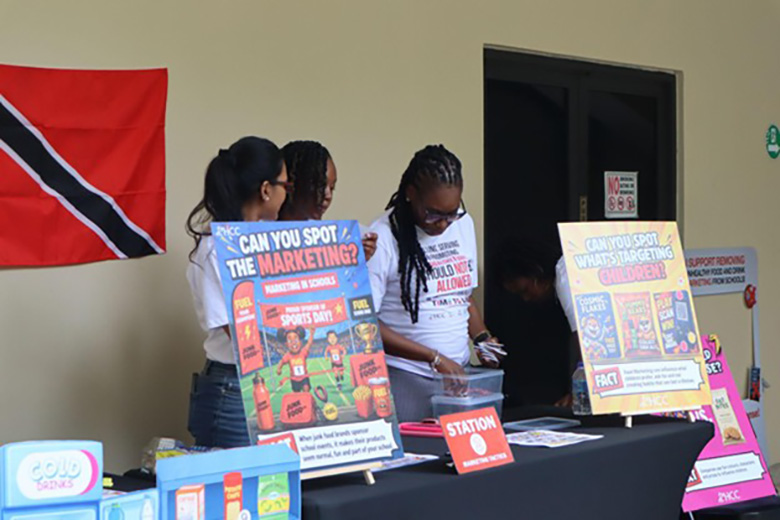
In Trinidad and Tobago, civil society organisations put their campaign into action by creating a game-based learning experience for students, teachers and parents aimed at raising awareness about the influence of marketing for unhealthy foods. Organisations involved included the Diabetes Association of Trinidad and Tobago (DATT), Trinidad and Tobago Association of Nutritionists and Dietitians, Trinidad and Tobago NCD Alliance(TTNCDA), Mindwise TT in collaboration with the Healthy Caribbean Coalition and the Healthy Caribbean Youth. The project was piloted on June 5, 2026 at DATT’s National Primary School Quiz Finals and featured stations that covered ultraprocessed product examples, marketing tactics used to promote these products and influence food choice, as well as provided opportunities for ideas to be shared on ways the school environment could be made healthier. Students, parents and teachers alike did not hesitate to share their experience on how marketing influenced their food choice daily. Several parents shared support for the efforts being taken to raise awareness of the promotion of unhealthy foods in schools, while students made bold calls for healthier food and beverage options at their schools. Numerous calls were made for fruit bowls, vegetable salads and even coconut water to be added to their cafeteria menu.
Local organizations are aligning with the government’s strengthened school nutrition standards and goal to place “restrictions on the marketing and promotion of unhealthy foods and beverages within school environments” as outlined in the recent media release. Youth partnerships in the implementation of school nutrition policies as seen in Barbados and Jamaica has had great success. Youth advocates understand the importance of a supportive school environment and have unique insight to shape and amplify health education campaigns to be just as persuasive as private sector marketing.
We believe that through this shared vision of health and wellness and taking inspiration from neighbours across the region, our goals can be materialised. Youth involvement supports effective and rapid change in our most urgent matters and maximizes the impact of resources invested to stem the tide of public health burdens. Our stance is strong and our passion is loud, paving the way for problems faced by youth to be solved and supported by youth.
 Rozette Scotland – Registered Dietitian, Healthy Caribbean Youth Member
 Charissa David – Registered Dietitian, Trinidad and Tobago Noncommunicable Disease Alliance program officer